ClipTraining
Semantic video search infrastructure powered by AI

Overview
ClipTraining’s platform teaches corporate employees software skills, Excel, Teams, Outlook, through a library of thousands of short video clips. The real problem was never the videos, it was that the right 40-second answer was buried inside a 20-minute tutorial, with no way to search for it. I approached that as a product problem before it was an engineering one, and because I have the technical fluency to take it all the way to production myself, I designed and built the full pipeline rather than just specifying it for an engineering team.
ClipTraining is the result: AI-powered search infrastructure that transforms the video library into a queryable knowledge base, so a user can search in natural language and land on the exact moment (minute + second) where the answer actually appears.
The Problem
An employee with a specific work question, “how do I share my screen in Teams”, shouldn’t have to scrub through a 20-minute video to find a 15-second answer.
- No semantic understanding of what’s actually said in a video
- Metadata is incomplete or inconsistent, so keyword search fails
- Users must manually scrub through videos to find the moment they need
- Scaling search across thousands of clips has to stay affordable, or it never ships
The Solution
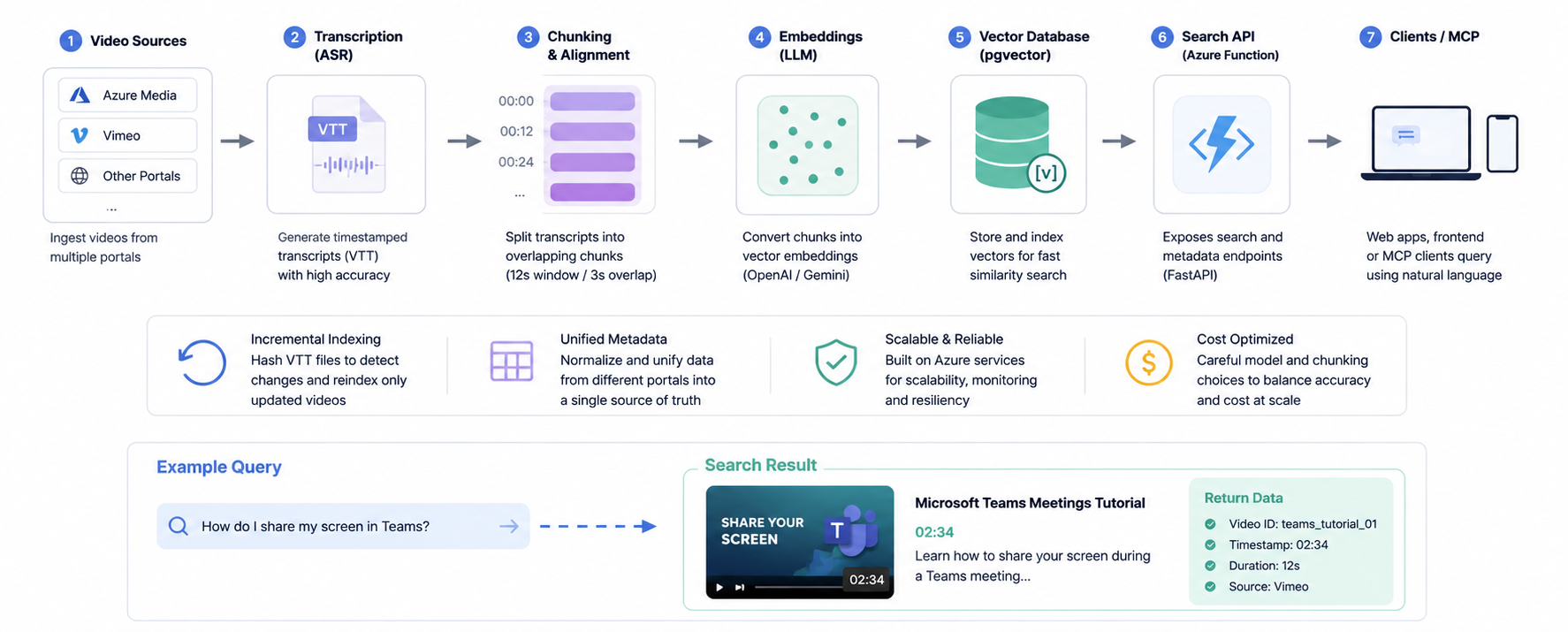
I designed and implemented an end-to-end pipeline that:
- Transcribes videos with timestamps
- Converts content into vector embeddings
- Enables semantic search via natural language
- Returns precise video segments
System Overview
Key Contributions
Transcription & Time Alignment
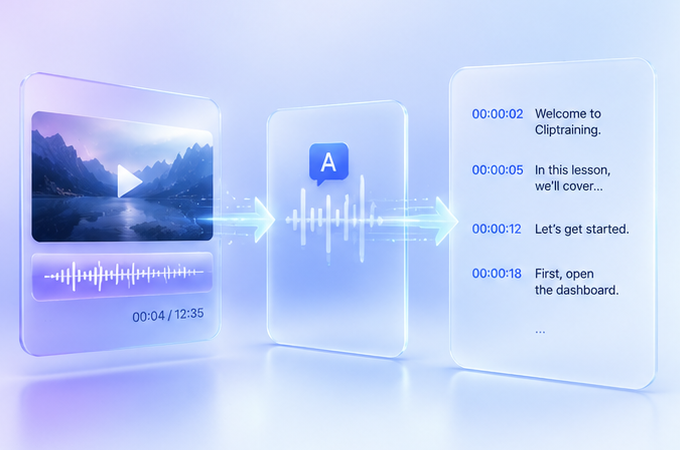
- Evaluated multiple ASR providers (Whisper, AssemblyAI, GCP, AWS)
- Generated accurate timestamped transcripts
- Improved alignment for precise segment retrieval
Metadata Enrichment

- Identified gaps in existing metadata
- Generated contextual metadata using LLMs
- Improved search relevance and discoverability
Chunking Strategy (A/B Testing)

- Tested multiple chunk sizes and overlaps
- Evaluated impact on retrieval accuracy and latency
- Selected 12s window / 3s overlap, tuned against how someone actually phrases a spoken work answer, not just abstract benchmark accuracy
Embeddings & Retrieval

- Benchmarked OpenAI vs Gemini embeddings
- Optimized for semantic accuracy vs performance tradeoffs
- Enabled similarity-based search beyond keywords
Vector Database Architecture

- Evaluated Pinecone, FAISS, ChromaDB, and pgvector
- Implemented scalable storage and retrieval layer
- Designed for fast similarity search across large datasets
Incremental Indexing
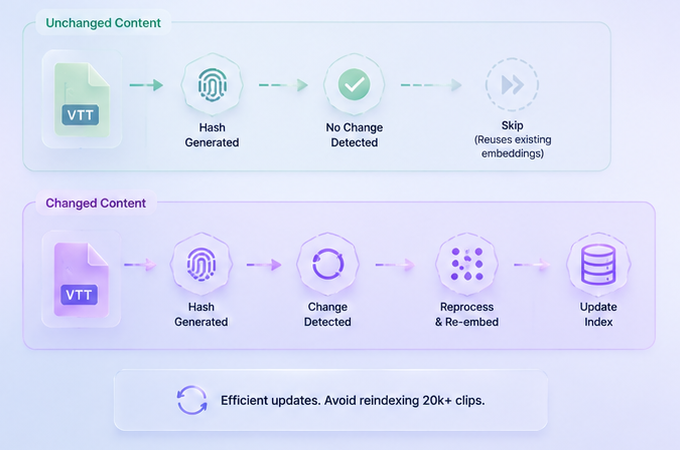
- Avoided full reprocessing of ~20k video clips
- Implemented hashing strategy on VTT files
- Re-index only modified content
Search API (Production Deployment)
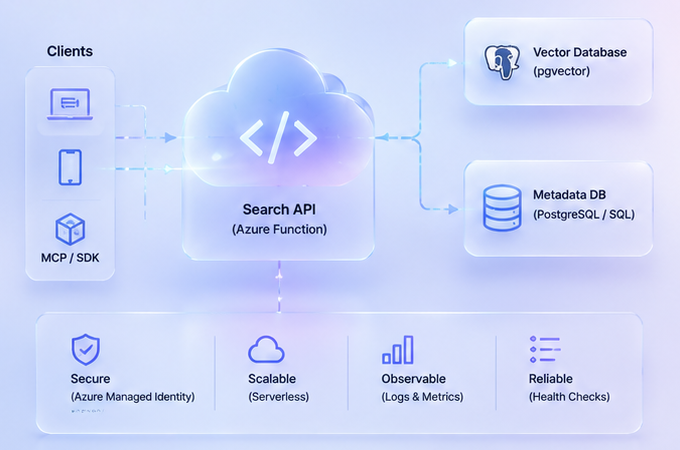
- Built FastAPI service deployed on Azure Functions
- Endpoints:
/search/index/health
- Integrated with PostgreSQL (pgvector) and Azure infrastructure
Cost Optimization
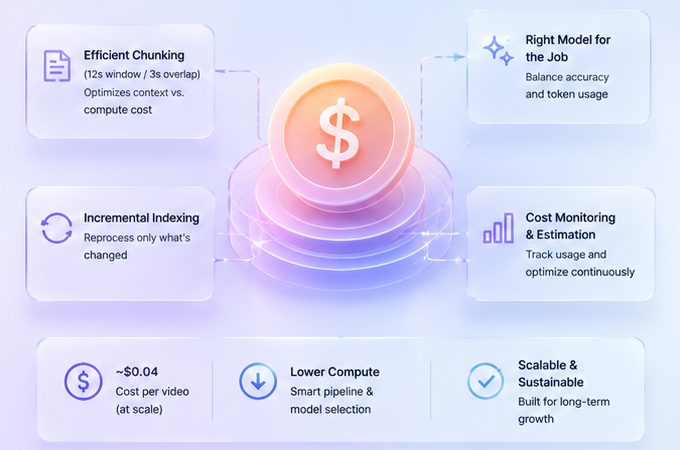
- Modeled API costs for transcription, embeddings, and metadata
- Identified low per-video cost (~$0.04 at scale)
- Balanced accuracy vs compute efficiency
Example Output
Query: “How do I share my screen in Teams?”
Result:
- Video: Teams Meetings Tutorial
- Timestamp: 02:34
- Segment: “Click the share button in the meeting controls…”
Outcome
- An employee’s 40-second answer is now a search away, not a 20-minute video away
- Production-ready semantic video search system, scaling to ~20k video clips
- Enables conversational and API-based search experiences
- Ready for frontend integration and enterprise use
This is the most technically demanding project I’ve built end to end, and I’d make the same call again: a product designer who can take a real user problem all the way through infrastructure decisions to a shipped system finds different tradeoffs than a pure engineering brief would.
Key Learnings
- Chunking strategy has a major impact on retrieval quality
- Metadata + semantic search (hybrid) significantly improves precision
- Cost modeling is critical for scaling AI systems
- Incremental pipelines are essential for real-world deployments